

Indoor RC Flying
Just a few years ago, practical indoor rc flying was only a dream, but today it is a very real activity. This is good news for those of us who live in colder climates.
Indoor rc airplanes can fly in large gymnasiums, recreation centers and meeting halls, and some even in a living room!
These airplanes are sometimes conversions of free-flight airplanes, such as the "stick-and-tissue" rubber-band powered balsa wood kits. New designs have also emerged that take advantage of space-age materials such as foam, carbon fiber, and mylar.
The advances in (a) miniaturization of electronic components, and (b) lightweight batteries such as Lithium Polymer, have greatly advanced this portion of the hobby. Complete airplane plus airborne components can weigh as little as 1 ounce!
Some of the popular equipment choices include the KP00 motor and gearbox combos, and the RFFS receiver and speed control combos. Instead of servo motors, lightweight magnetic actuators are used to move the control surfaces.
One popular plane for the larger indoor spaces is the GWS Lite Stik, or the Pico Stick. This is really easy to put together and flies very slowly and stably.
In test flights, I found that the recommended 6 cell 110mAh NiCad pack is a bit weak. After switching to a 7 cell 350mAh NiMH battery the flight performance was much better.
While the RC Airplane Advisor is primarily about airplanes, no discussion of indoor RC would be complete without mention of one of the best confined-space aircraft: the helicopter. In this case, electric micro rc helicopters.
These have been around for some time, but until recently have been known for being less stable to hover than larger, outdoor helicopters. That has changed with the introduction of coaxial micro helicopters, which feature a pair of main rotors that spin in opposite directions.
These counteract each other's torque, making for a very stable machine. Micro helis can be flown indoors, they're that stable.
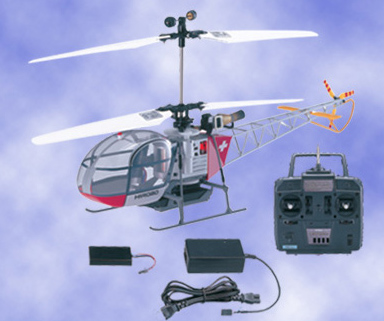
Hirobo Lama indoor rc helicopter.
One great example of these machines is the E-Sky LAMA V4 RTF Coaxial RC Helicopter, available from Rite Hobby. Be sure to check out the cool video at the bottom of the Lama V4 page.